Looking for something?


Posts Tagged ‘Posterscope’

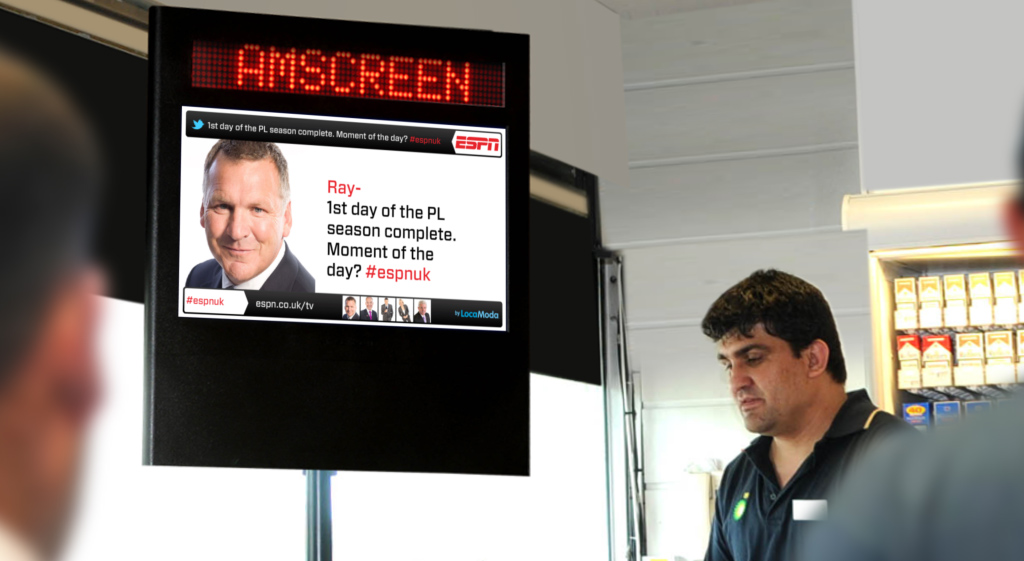
Over this past week there’s been some coverage about ESPN’s campaign in UK.

You can read about the campaign in Brand Republic, The DailyDOOH and Electric Avenue

Behind-the-scenes the ESPN campaign needed a multi-national effort and that should be a wake up call for people watching DOOH more closely.

Because this is becoming a turnkey requirement for all DOOH networks.

On the surface the ESPN campaign seems like an simple concept - real-time comments and tweets for the launch of UK’s soccer season. But anything real-time that runs across multiple networks is no walk in the park.

The campaign required 14 different configurations for 8 networks and 300 screens. Some of the networks were ready and able to run real-time content - others less so. Some cached content until it was updated, others did not. Some updated in real time, others updated at discrete intervals. Some had a reliable hard-wired, persistent Internet connection, others had intermittent wireless connections. Some screens were portrait, others landscape, some super wide “banners”. Some had square pixels, other had oblong pixels.

That’s what we deal with at LocaModa every day. And agencies and media buyers really shouldn’t be exposed to these issues.

Cross channel DOOH might be difficult today but it’s the future because no single network can be all things to all brands all the time.

In short - media buyers and agencies want to know that their campaigns can run across multiple networks in a standard way - if that isn’t possible, networks with a propriety solution (or no solution) will be less able to attract advertisers.

I predict the type of campaign that was executed for ESPN will be run-of-the-mill within 12 months. For that reason, this was not innovative, but was also a really big deal - and Posterscope and Arena Media - the teams working in the trenches with LocaModa to make this happen - are to be congratulated. This is critical step for the development of the UK DOOH market.

Share

Escaping multiple snow storms this week in Boston, I’ve joined James Davies, Chief Strategy Officer, Posterscope on a week long series of thought leadership talks in London with leading agencies about the opportunities and lessons around social media and OOH. James and I had jointly written a paper on the subject which you can download here.

I get pretty inspired when I meet clients and get insights about local issues/challenges/opportunities, and this trip is no exception. Happily, I’ve also been more than a little suprised by the fast pace, innovation, responsiveness and attitude that I have experienced here.

My big takeaway is that the DOOH market in USA is not just attracting global attention, it’s also encouraging global companies to participate and innovate in the market (LocaModa’s partnership with Fujifilm Imagetec is one example). Companies far and wide are inspired by what’s going on in USA and are doing something about it. In many cases, they can move faster - their markets have less baggage, less fragmentation and often (as is the case with Posterscope) already have excellent tools to simplify the DOOH media planning and buying process.

I’ve also seen some beautifully executed DOOH here - for example in major underground stations. My gut feel from just a week in my old stomping ground is that the UK DOOH market is primed and ready to move.

USA DOOH is leading by example - now we need to make sure we continue to innovate, execute and drive a global industry forward.

Share

James Davies, Chief Strategy Officer of Posterscope and I have just released a white paper: “Sociable Media. Seven ways to connect online and offline social experiences to deliver engagement, advocacy and brand affinity.” You can download it free here.

Working with James on the white paper exposed me to some of his and his agency’s thinking about the role of OOH as a critical compliment to other channels. Prior to meeting James, I had been guilty of thinking of the digitization of OOH only in terms of digital billboards. But digital billboards are not the most significant movement of OOH towards all things D. In fact less than 1% of billboards are digital (according to the OAAA).

The more significant evolution in OOH is its ability to work in conjuction with other channels so well. OOH has been quietly pioneering cross-channel connectivity because it has to. It recognized (as all media should) that it has to be a complimentary channel because the customer today is not captive to any screen.

The familiar phone number on OOH billboards is today often replaced with easier to comprehend (or remember) Text short codes, QR codes, Twitter hashtags, Facebook fan pages and urls.

As the white paper’s introduction states, a unique new communications dynamic is being created by the convergence of four media opportunities: online social networks, social networks in the real world, mobile and Out-of-Home media, especially digital and experiential. The paper outlines how advertisers can leverage these channels in various combinations to turbo-charge the effects of both online and Out-of-Home activity and enable a more sociable approach to consumer engagement.

In addition to understanding the role of new media channels in isolation, advertisers need to be mindful of how they interact with each other and with traditional media.

The message time and time again is this simple: As media fragments, the ability to work across channels is one of THE most important features of any communications strategy. Traditional media is “getting digital” fast.

Share