Looking for something?


Posts Tagged ‘out-of-home’

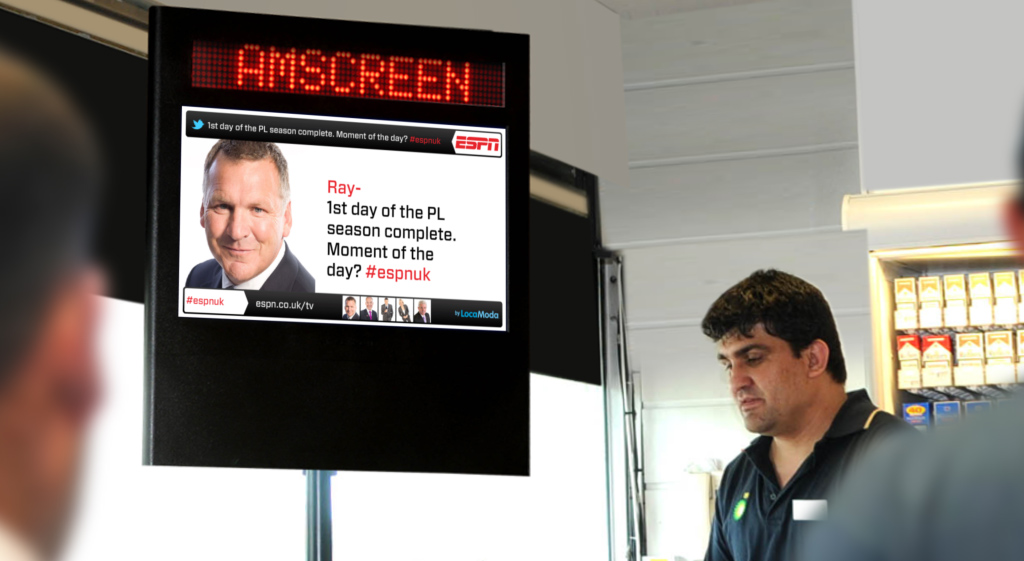
Over this past week there’s been some coverage about ESPN’s campaign in UK.

You can read about the campaign in Brand Republic, The DailyDOOH and Electric Avenue

Behind-the-scenes the ESPN campaign needed a multi-national effort and that should be a wake up call for people watching DOOH more closely.

Because this is becoming a turnkey requirement for all DOOH networks.

On the surface the ESPN campaign seems like an simple concept - real-time comments and tweets for the launch of UK’s soccer season. But anything real-time that runs across multiple networks is no walk in the park.

The campaign required 14 different configurations for 8 networks and 300 screens. Some of the networks were ready and able to run real-time content - others less so. Some cached content until it was updated, others did not. Some updated in real time, others updated at discrete intervals. Some had a reliable hard-wired, persistent Internet connection, others had intermittent wireless connections. Some screens were portrait, others landscape, some super wide “banners”. Some had square pixels, other had oblong pixels.

That’s what we deal with at LocaModa every day. And agencies and media buyers really shouldn’t be exposed to these issues.

Cross channel DOOH might be difficult today but it’s the future because no single network can be all things to all brands all the time.

In short - media buyers and agencies want to know that their campaigns can run across multiple networks in a standard way - if that isn’t possible, networks with a propriety solution (or no solution) will be less able to attract advertisers.

I predict the type of campaign that was executed for ESPN will be run-of-the-mill within 12 months. For that reason, this was not innovative, but was also a really big deal - and Posterscope and Arena Media - the teams working in the trenches with LocaModa to make this happen - are to be congratulated. This is critical step for the development of the UK DOOH market.

Share

James Davies, Chief Strategy Officer of Posterscope and I have just released a white paper: “Sociable Media. Seven ways to connect online and offline social experiences to deliver engagement, advocacy and brand affinity.” You can download it free here.

Working with James on the white paper exposed me to some of his and his agency’s thinking about the role of OOH as a critical compliment to other channels. Prior to meeting James, I had been guilty of thinking of the digitization of OOH only in terms of digital billboards. But digital billboards are not the most significant movement of OOH towards all things D. In fact less than 1% of billboards are digital (according to the OAAA).

The more significant evolution in OOH is its ability to work in conjuction with other channels so well. OOH has been quietly pioneering cross-channel connectivity because it has to. It recognized (as all media should) that it has to be a complimentary channel because the customer today is not captive to any screen.

The familiar phone number on OOH billboards is today often replaced with easier to comprehend (or remember) Text short codes, QR codes, Twitter hashtags, Facebook fan pages and urls.

As the white paper’s introduction states, a unique new communications dynamic is being created by the convergence of four media opportunities: online social networks, social networks in the real world, mobile and Out-of-Home media, especially digital and experiential. The paper outlines how advertisers can leverage these channels in various combinations to turbo-charge the effects of both online and Out-of-Home activity and enable a more sociable approach to consumer engagement.

In addition to understanding the role of new media channels in isolation, advertisers need to be mindful of how they interact with each other and with traditional media.

The message time and time again is this simple: As media fragments, the ability to work across channels is one of THE most important features of any communications strategy. Traditional media is “getting digital” fast.

Share

numbersAs we prepare for NYE, the anticipated busiest day of our cross-channel campaign with Vans, we’re faced with the question of measurement. Multi-multi-measurement.
To put it mildly.

Let’s back up. Single-modal campaign stats can be broken down into fairly standard tables with the traditional cast of characters: users, pageviews, impressions…

Even digital or otherwise ‘dynamic’ campaigns have become digestible enough over the past few years; interactions like clicks and txts have accumulated the necessary precedence to be adopted into the common marketing vernacular and hold meaning at face value. In most cases, digital numbers can be chopped finely enough to be contained within a traditional analytic structure (with possibly a few relational clauses and an asterisk or two).

But what about a campaign that asks users to click, txt, view, visit, watch, write, submit, photograph, playback, share, and embed? And do so in their own particular way, using whatever combo of devices they want, globally, 24/7?

Welcome to our world.

Cross-channel campaigns like Vans BeHere require an entirely new measurement rubric- one that involves far more than Excel tables and line graphs. User engagement becomes a complex equation involving all of the verbs above, some multiplied, some summed. But here’s the kicker: the three-click rule still applies, and it’s no longer confined to just the web or the mobile phone. When ‘spreadability’ reigns, you just better make sure that you let the user decide which three clicks (or txts, or playbacks, or embeds) he wants to make.

From a brand perspective, the ultimate success of a campaign like this isn’t raw numbers; that’s far too compartmentalized and myopic to mean much of anything. The ‘win’ here is verifying that the audience has been given the tools to craft their own user experience in an instinctual way, and can then pass these tools to friends (so that they can then use them in their own way…) Boiled down, it’s a matter of containing viral spread to the point that it captures and engages a critical mass of target users without losing effect.

Toss that in your pie chart.

Share

CEO @StephenRandall found this floating around the internet. It’s a “notificator” or robotic messenger used in the 1930s for friends to leave messages for each other at a specific location. People put a coin into the machine and wrote a message on a continuous strip of paper that stayed up for at least two hours.

Digg calls it the First Twitter, but it’s really more like the First Wiffiti, with the whole broadcasting a message to a screen for all to see.

While essentially the two fulfill the same purpose of connecting people, I have to say our Wiffiti’s a bit more advanced. It’s bigger, quicker and allows you to connect to a lot more people at a lot more places.

Share

Another app hits the big screen…

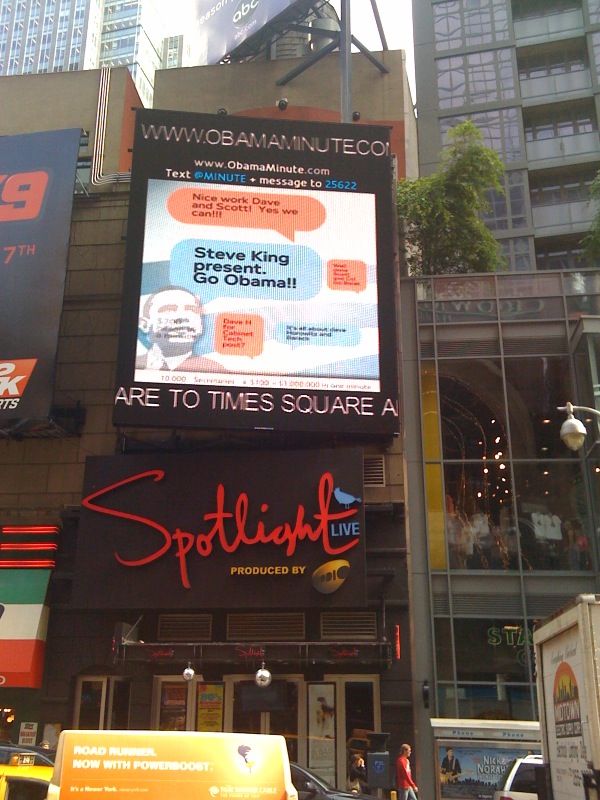
Working with the good folks over at ObamaMinute, we’ve launched Obama Wiffiti in Times Square!

This will be running 24/7 through the election, so crank up your texting to show your support! And, if that’s the way ya swing, head on over to ObamaMinute and register to be part of “An Obama Minute” on Monday, October 6th at noon. They’ve been a wonderful group to work with!

You can also embed this screen into your own blog or website and spread the love (it’s just a quick copy/paste of code at the bottom, just like you’re embedding a YouTube vid).

As you can see, Steve King, our VP Sales, is in NYC today and wasted little time making his presence known… :)

Share