Looking for something?


Posts Tagged ‘LocaModa’

Companies using social media to connect to people and places need to support the multiple tools and methods that their audiences use. However, if you were to ask 10 media savvy users how they send an update with a photo attachment, you’d probably get more than 10 answers.

LocaModa now supports even more interaction models via mobile or web using email, txt, Twitter and more….

For example, we support all the strange things that mobile phone email clients do, such as unusual MIME structures, or including the numeric mumbo-jumo that many carriers have implemented and include in their email subject lines. So friendly.

If a message includes a URL or short URL which looks like it might point to an image, we can display that image (assuming the message passes our filters and the image is moderated).

We also support a whole host of photo sharing apps on Twitter clients including yFrog (which also supports video), TwitPic, Lockerz, TweetPhoto, Instagram, img.ly, Lightbox and can display JPEG, PNG, BMP, TIFF and GIF images.

We also get requests from customers that want their audiences to be able to email directly to local screens. Every LocaModa-enabled screen has a unique address such as JOESBAR. This address can also be used as an email address for example [email protected]. In this case, any text in the email’s subject line can be copied into the body of the Wiffiti message. That method can also be used to email a photo to a screen, with the photo’s caption being the email subject line.

Some of this might seem a little geeky, but we now enable networks with over 30,000 venues and our platform has also enabled 80,000 Wiffiti screens for events, as well schools and churches, so we’ve given up being surprised by what our customers want to do with our platform.

If there’s a feature that you want and we don’t support, we’d be happy to consider it for our roadmap (but if it’s too esoteric you might need to bring your checkbook!).

Share

Once upon a time, American’s didn’t believe in text messaging. Believe me, as a newly arrived Brit, obsessed with mobile tech, my American colleagues used to say I was insane to think a small screen could ever be as interactive or engaging as the Internet. They told me on numerous occasions that what works in Europe or Japan is irrelevant in USA.

I’d seen the roadmaps of the then leading handset companies as a founding exec at Symbian. I believed (and still do) that the human requirement to find the best communication tools, be they cave paintings, morse code or text messages, transcends even the weirdest cultural differences between USA, Europe and Asia.

OK - I was right on that one.

And they do say history repeats itself.

So here we are some 10 years on, and yes, many people are talking about social media, but not so many companies are actually practicing what they preach.

So will the messaging market once again be tipped by Simon Cowell? I think so.

Last week, in his new hit reality pop culture show, The X Factor, he announced that the TV audience (once passive) could start voting via Twitter.

This is more than a sign of the times, it’s really smart.

Voters will have to follow the show before they can Direct Message “DM” their votes. This will create waves of trending mentions (even more than it currently gets) in the “Twittersphere”. That will in turn help promote the buzz around the show.

Mark my words, here we go again. Once a “cool” technology goes mainstream, companies have to do or die.

Share

Taking content designed for a desk-based user experience and displaying it on a place-based screen meant for an audience more than 10 feet away is stupid a common mistake made by many DOOH practitioners.

A good real-time social feed for events or venues needs to:

a) Attract attention
b) Sustain interest
c) Be easily readable by the entire intended audience.

I’d like to address these points using a real example of a feed used at one of our very own industry’s key events, last weeks DPAA Media Summit event in NYC (which I wrote about here).

The screen shot below (taken from my Hootsuite setup) is similar to the initial experience that greeted me on a Twitter screen at last week’s DPAA event. I was sitting a third of the way from the front, in an audience of around 400 people.

There are good reasons why that type of design is not great for an event-based or digital out-of-home application.

While it was well placed to attract attention, being on stage, the execution was poor in relation to it’s ability to sustain interest (which I’ll come back to) and it completely failed with regards to its ability to be read by most of the audience.

I tweeted that I couldn’t read the tweets.

As the tweets shuffled up, the new (attention grabbing) message only commanded around 15% of the screens’ real estate. Not only is that insufficient real estate to grab and keep an audience’s attention, but it’s also competing with 5 other older messages, commanding around 85% of the screen, with the same weight as the new message.

To the credit of the person managing the DPAA’s Twitter screen, they noticed my message and responded by decreasing the number of tweets to 3.

That was an improvement but it didn’t solve the problem.

From the screen shot below (again taken from Hootsuite, not from the DPAA screen, but in any case, similar in structure to the DPAA Twitter screen experience) you can see that the attention grabbing new message now has around 30% of the screen real estate. This is better but it’s still competing with 2 other messages, equally weighted, and commanding about 70% of the screen.

Sustaining an audience’s attention is not only related to content and graphics it’s also related to the predicability of the program or timeline. For example, a news ticker may grab initial interest, but after a few seconds, it’s crawl becomes predicable.

The human brain is designed to pay most attention to the newest movement and sound. Long ago, those changes in movement or sound might have been life threatening. Once we recognize the movements, we can process them and, if they are not life threatening, we tune them out. (That’s why we don’t notice the continuous hum of an air conditioning system until it’s turned off.)

That might be good for our safety but not for DOOH applications.

The screen shot below shows a LocaModa Twitter screen. The difference is hopefully obvious. It’s been designed (and patented) specifically for venue and event screens, is attention grabbing, attention sustaining, easy to assimilate by the entire audience and fun.

The newest message is displayed almost full screen for a few seconds (enough time to notice and assimilate the content) commanding at least 75% of the screen real estate, then it settles into a dominant screen position.

The new message default configuration is the inverse of older messages - new messages typically set to a dark font on a light background. Older messages are smaller, and typically set to a light font on a dark background. Whilst readable, older messages are designed to NOT compete with the new message - they are really used to convoy the flow of messages and activity rather than give them equal status and weight to the new message.

The messages deliberately do not have a predictable movement - they jostle to find their right screen position based on their size and that also provides a sustainably engaging experience for the entire audience, not just the front row.

Less is more.

Big is beautiful.

Content is king - if you can see it.

Share

I spent most of Monday at the DS Investors Conference and most of Wednesday at the DPAA 2011 Digital Media Summit.

What was notable at both events was that almost every speaker talked about leveraging the connection between DOOH screens and their mobile audience, multi-channel strategies and leveraging mobile and social media technologies.

What was different this week was that this buzz was not limited to the “interactive tent” - it was center stage. What used to be a lonely platform for way-too-early entrepreneurs and evangelists like me, is now well and truly an accepted part of our agenda.

I’m not convinced that every speaker at the conferences was “eating their own dog food” but I can’t gripe - obviously we still have some way to go, but at least the entire industry is talking about it.

There are various stages in the maturation of a digital market, and in my opinion, we’ve reached the end of the beginning.

Borrowed from an earlier Gartner paper, what I touched on in The DOOH Slope of Enlightenment suggests that digital markets move through various stages staring with a “Peak of Inflated Expectations” where the market experiences a fool’s gold rush and invariably early adopters pay the price for being early. The market then moves through a downward trend where it adjusts to a “Trough of Disillusionment” and finally it reaches a point where companies actually release products that exceed users’ expectations. At that point, the market can start to move up the “Slope of Enlightenment.”

As the web evolved from digital brochureware, so too are DOOH screens finally being forced to be more than slideware. Some are and many more will be more connected, more engaging and, as a result, more valuable.

Judging not only from the majority of speakers’ inclusion of all things mobile and social, but also the stream of Tweets from users at both events and even the inclusion of a Twitter screen at the DPAA event - I would say we are at the end of the beginning of DOOH. We are standing at the beginning of the Slope of Enlightenment.

Do you agree?

Share

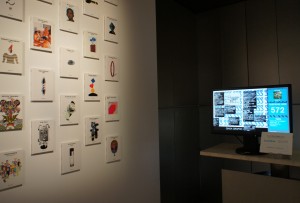
The Ginza Graphic Gallery’s 25th anniversary commemorative exhibition brought together 100 beautiful books by 100 (probably equally beautiful) designers. More details here.

Also on display was the gallery’s first e-book and a Wiffiti screen which was tagged to show filtered tweets about the exhibition and Foursquare check-ins.

The event was planned and organized by DNP Foundation for Cultural Promotion and the local technology providers of the Wiffiiti screen were Fujifilm Imagetec.

Share