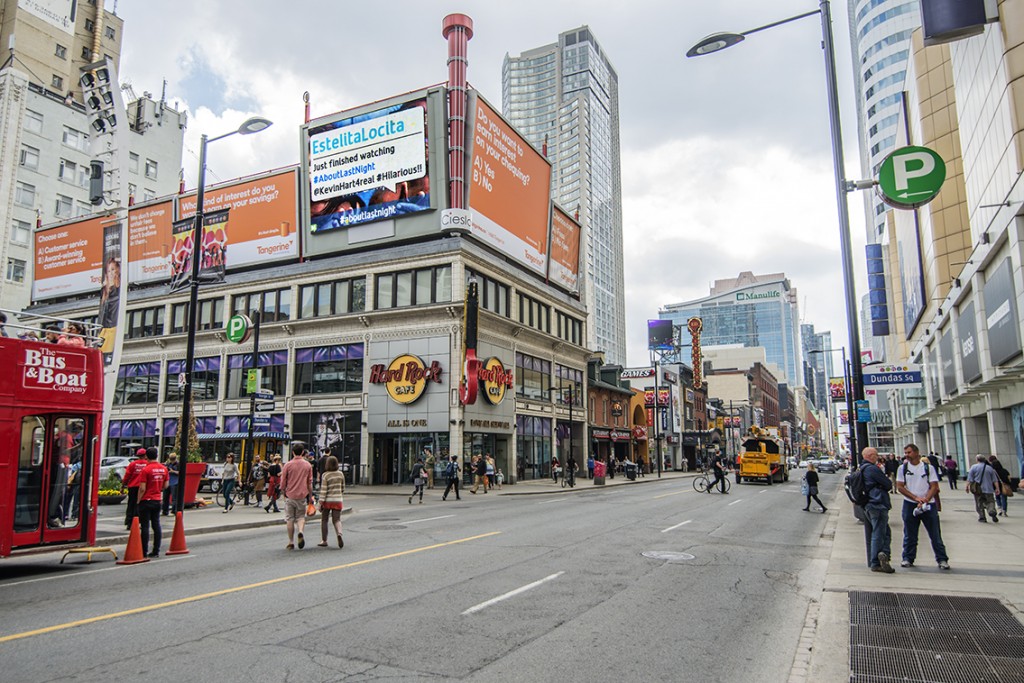
Monster Social’s Wiffiti application spotted in Toronto’s Dundas Square, promoting Sony’s About Last Night. Now that’s a hashtag asking for moderation :)
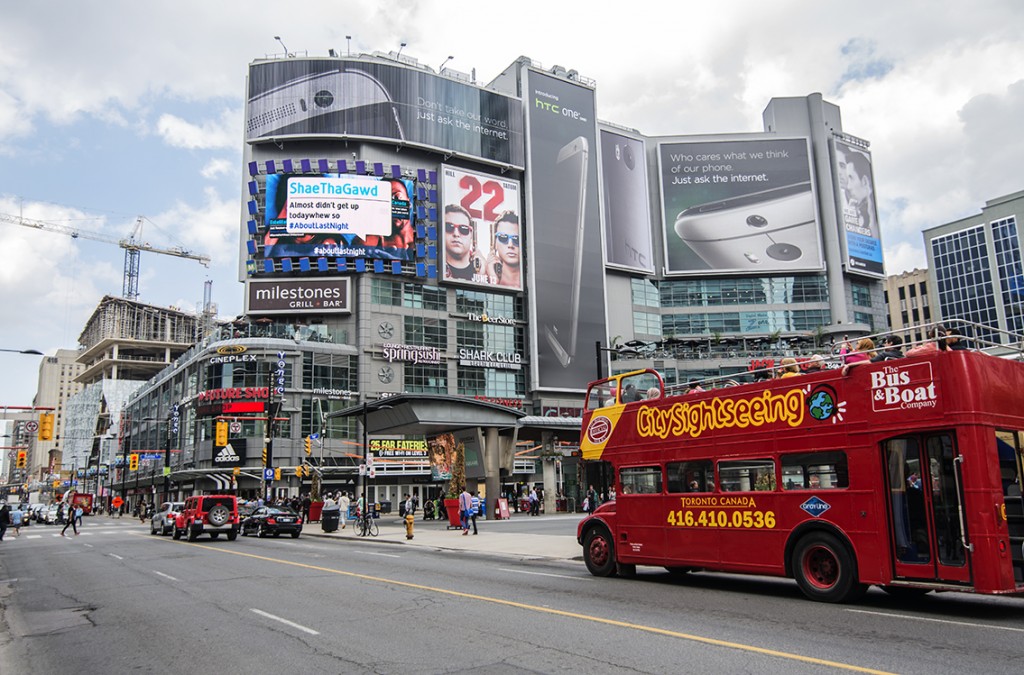

Monster Social’s Wiffiti application spotted in Toronto’s Dundas Square, promoting Sony’s About Last Night. Now that’s a hashtag asking for moderation :)
The convention, trade show and meeting industry in 2012 generated more than 1.8 million meetings in the U.S. involving an estimated 225 million participants (Source PricewaterhouseCoopers). 50% of meeting participants were corporate/business meetings, 27% conventions/conferences/congresses and trade shows accounted for 12%. Not including travel-related spending, $150 billion was generated by meeting planning and production, venue rental, and other non-travel & tourism commodities.
It’s no surprise that such a significant and competitive industry is always searching to maximize value for busy attendees and exhibitors. And it’s no coincidence that Monster Social, the platform developed by Monster Media and LocaModa (the company Monster acquired in 2013) to help Out of Home networks amplify audience engagement is being leveraged in the convention industry to deliver more valuable event experiences.
Freeman, one of the largest event and conference service companies in the world, produces over 4,000 exhibitions worldwide every year. Richard Reid, Vice President, Freeman Audio Visual Digital Services, sees social media as more than a communication tool. “Freeman’s success depends on our ability to deliver impactful experiences, faster, smarter and flawlessly. In today’s business climate, utilizing Freeman’s Digital Services social media solutions to effectively generate a better person-to-person “return on connection” is key.”
To Richard Reid’s point, in order to deliver “fantastic ideas quickly and flawlessly” technology not only needs to be VERY configurable, but the team behind it also need to be VERY responsive and VERY flexible. With the production of so many events every year, Richard’s team depends on the reuse and flexibility that platform technologies provide to rapidly tailor innovative signage solutions for their clients.
On top of that prerequisite, social media is evolving rapidly. Features, Application Programming Interfaces (APIs) and even commercial Ts&Cs are not standing still. Companies that develop social media platforms need the DNA to adapt quickly.
As it evolves, Social media is moving to center stage - literally. It is no longer a “nice to have” feature of an event:
- Social walls are used to inform attendees about event news in realtime and reduce perceived wait time in busy areas.
- Connected messaging services and applications spread news beyond the event and in turn feed on-line and mobile reactions back onto event screens to enable more informed attendees and create an even bigger buzz.
- Hash tags are being leveraged to display audiences Q&As in panel sessions.
- Interactive social maps can display realtime infographics about attendees.
- Moderation, filtering and curation tools help get the right message to the right people at the right time.
Since the start of 2014, Freeman has produced over 40 events using Monster’s social media platform. Each event requires a different configuration depending on whether the screen placement is on stage, in a hall, an entrance or a booth. Message size, speed, number of messages, call to action, filters, etc., all need to be configured depending on the event and sponsor requirements as well screen placement. The application needs to inform, entertain, market, and reduce perceived wait time. It must also accommodate a sponsor’s or brand’s logo(s), messages, products etc.
That’s a tall order, and companies like Freeman use social media not only as a tool to improve the event experience, but also as a means of offering more end-toend services and solutions. For example, where they might have provided “just” screens, stands and connectivity, they can now provide the real time content on those screens.
How does a company like Freeman select their social media platforms? Many social media tools have been developed by people who do not understand the UX challenges of the event space. The last thing a sponsor wants is to display social media that is too small to be read at the back of the room, or scrolls in such a uniform way that the audience tunes it out after 15 seconds (our brains are predisposed to notice random movement above uniform movement). The UX for a screen that’s 10 feet away has to be very different to that of a screen 10 inches away. A UX designed for the web experience is rarely a good solution for an events.
Many social media tools are designed as “eye-candy” first with little attention to the above challenges and even less attention to adherences to the terms and conditions of the streaming services many re-syndicate without permission. What might be fine for a DJ to project at a club is not necessarily fine for a multinational sponsor to project at a conference. Dealing with multi-million dollar events, it is imperative that the solutions our clients use are robust, tested at scale, easy and fast to use and legally sound.
As one client asked me recently “What do I say tell people who expect social media to be free?” I suggested they remind their customers that even though they can download music for free illegally, would they provide music that way for clients paying many thousands of dollars for a professional risk-free execution?
And that point raises other legal issues around social media. Freeman knows that it is even more important when providing solutions for public consumption to be mindful about specific legal requirements. There are the standard terms and conditions that each social media source require of their partners as well as copyright questions that can come into play. For example, Twitter does NOT permit companies to re-syndicate it’s tweets without explicit permission. There are granted patents for systems and methods of social media on public displays (see this post for more info). Do companies break these rules? Yes. Should they? NO. Do you want to knowingly provide solutions that could put you or your clients at risk? Of course not.
Recent conferences enabled by Freeman via Monster Social include:
Connected Car Expo: tweets were used during the show on social walls and in session’s question time with realtime moderation. Over 3000 tweets were sent during the two day show.
2014 Genitourinary Cancers Symposium: Freeman Audio Visual worked with ASCO’s social media team to develop a solution that would allow them to incorporate their online social media presence into their live event and to display tweets between the General Sessions. Medical tweets are typically longer than average tweets and Freeman was able to easily program the experience to have longer message “hang times”. Over the two day event, #GU14 received more than 1800 tweets, all of which were recorded by Freeman’s social media analytics reporting tool and provided to ASCO post-show.
OTCHouston: The Offshore Technology Conference is an international trade show with global attendees from the oil industry. The show was used to premier Social Map, a new social media template developed by Monster. Attendees can tweet the conference hashtag together with their country to see a world map info graphic display the attendees from each country. This is a digital version of the old pin-board maps where attendees place their business cards on a map. With Social Map, there is a realtime interface to capture the same information.
We’re only scratching the surface, but from the excellent feedback Freeman are getting, we know that event organizers and attendees see these products as essential engagement tools.
Late last week our partner manager at Twitter called me with some good news.
Twitter has backed down on a requirement that its broadcast partners (that includes TV, Out of Home, Stadiums, Events etc) be exclusive to its platform.
Twitter was requiring it’s partners to drop features that enable other rival social platforms and streams being displayed on out-of-home screens and networks.
As Re/Code reported, Twitter has decided to get along with Facebook, after all.
We should not be surprised that any public company has its biggest brains exploring ways to improve their competitive advantage. More than ever, it behooves the market to be aware of the ever changing social media landscape. Stay tuned.
As some in the Out of Home (OOH) world head out to Vegas for DSE2014 (Digital Signage Expo), Monster Media today announced that it has been granted a patent for social media on Out-of-Home screens.
The patent, 8,615,565 “Automatic content retrieval based on location based screen tags,” relates to the automatic retrieval and display of social media on location-based screens such as Out-of-Home networks and signage at venues, events and arenas.
Monster Media’s growing intellectual property (IP) portfolio contains two issued patents and numerous other applications focused on interactive engagement technologies primarily for Out-of-Home applications covering mobile, social, touch and gesture technologies.
The granted patent describes how to amplify audience engagement on Out-of-Home screens. LocaModa, a company acquired by Monster Media in August 2013 (full disclosure, I was the founder and CEO of LocaModa) invented a number of products that improve engagement for Out-of-Home networks.
Automatically creating a sustainably interesting screen was a problem that needed to be solved for our industry. Simply using local messages or single content sources gets boring very quickly as audiences lose interest if content is repeated. We solved the problem by leveraging conversations across multiple networks and tagging those conversions with keywords that the local screens then subscribe to. Of course we filter the content to make sure that it is appropriate for each venue, but the result is an automatic system that increases interest in and value of the media.
Monster Media’s IP, which pre-dates the now popular use of hashtags in social media, is regularly used to systematically aggregate, filter and display Twitter, Facebook, Foursquare and Instagram on Out-of-Home and event-based screens. The company’s technology platform enables Out-of-Home campaigns reaching more than 100 million people every month for brands including AT&T, Clorox, ESPN, Levis, Gap, Pepsi, Sony, Paramount, Tide, New York Rangers, Miami Dolphins and Ciroc.
As some know, LocaModa, the company I founded over 10 years ago, developed a number of firsts for the OOH and DOOH market. Way ahead of our time, we patented a suite of technologies that made screens more engaging and measurable.
In my opinion, this is a biggie - it’s a core part of Monster Meida’s value proposition and it’s fundamental to the best practices and industry standard that I helped draft for the OAAA (that Stephen Freitas will be speaking to at the OOH session at DSE2014 this week).
In essence, the predominant way social media is being used on OOH networks and at events hits this patent and clearly, as our market get serious about leveraging real time media to enable more engaging OOH screens and events, it has to be mindful about IP issues.
One side impact of this patent is that it can help remove friction from our market. By way of an example, assume network A and network use different content management systems, have different screens formats, but use the same standardized method of deploying social media. A brand or agency can now deploy social media to both networks without needing to worry about their different CMSs and screen formats. This means we (finally) get less friction in our market.
In much the same way as the internet exploded only once the browser sat on top of different platforms - and resulted in the revolution of frictionless media, we can only hope that something similar happens in the OOH industry.


